
|

|

|
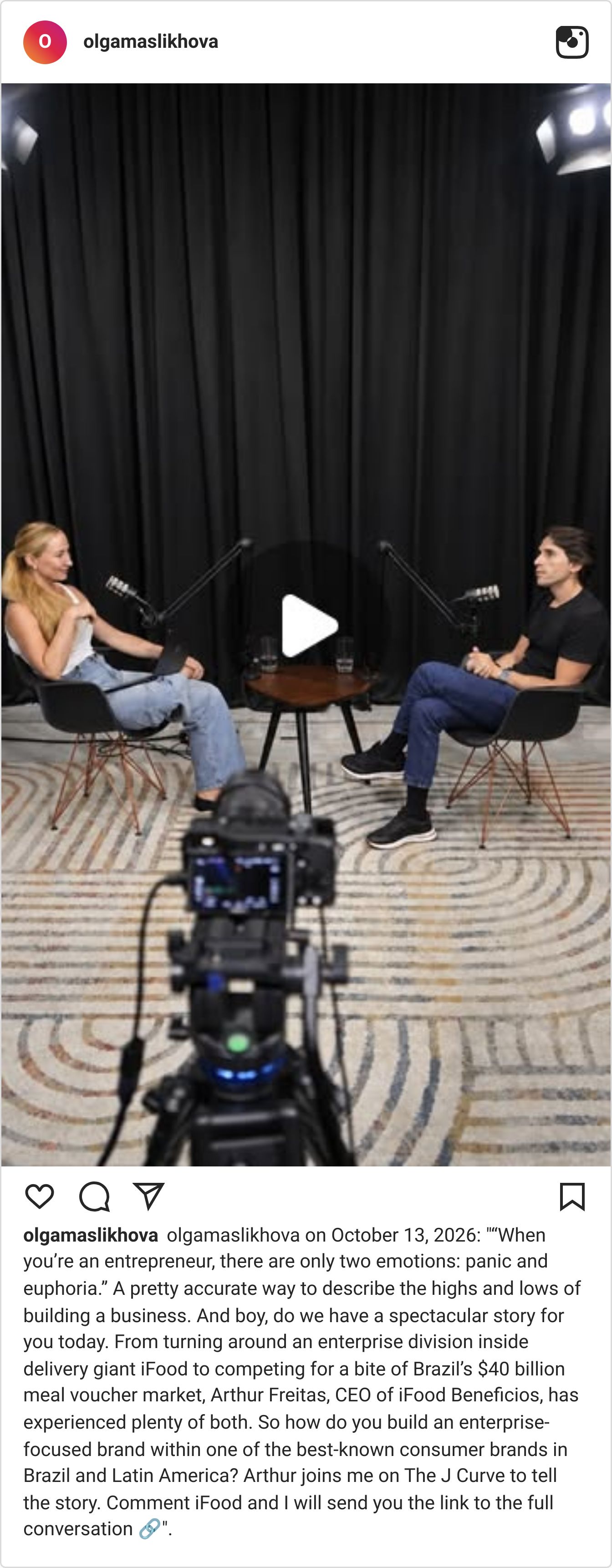
New TJC episode is out today!! And guys, I vividly remember when Arthur Freitas told me that the meal voucher business in Brazil could eventually become even bigger for iFood than food delivery. That sounded absolutely nuts to me. I knew iFood. I knew the delivery business. But I had never really heard about this industry, let alone imagined that it could represent an opportunity of that size.
So I sat down with Arthur, who leads iFood Benefícios, to understand how this market works—and how he turned a business that was at risk of being shut down into one growing triple digits every year.
At the time of our conversation, iFood Benefícios was processing roughly $220 million in monthly transactions, serving 1.5 million users and adding between 60,000 and 80,000 new employees to its base every month.
But to understand how extraordinary that is, you have to go back to what Arthur inherited. When he took over, iFood Benefícios was processing roughly $40 million a month and burning millions of dollars. Growth had stalled, and there was a real possibility the business would be shut down.
And to understand what went south, you need to know a little about how Brazil’s meal voucher industry works. For decades, employers chose providers partly based on the rebates they received. The providers funded those rebates by charging restaurants high fees. Arthur described a market where four companies controlled more than 95% of the business.
Then newer players introduced cards that used existing payment networks, giving employees far more places to spend their benefits—and charging merchants much lower fees. A better product for employees. But much less money available to offer employers the incentives they were used to.
And iFood Benefícios was trying to do both. It was offering the newer model while competing for large employers with expensive rebates. The result was negative gross margins: more transaction volume meant more losses.
So Arthur’s first challenge was to fix the economics of the business he already had. That meant everything from downsizing the organization to having hard conversations with customers—and letting some of them go when the incentives they expected simply didn’t make sense.
Then came rebuilding growth around SMBs, which weren’t used to receiving rebates. The team made the product easier to buy and use, and eventually brought in AI agents to handle much of the sales process.
And, of course, they went back to something the parent company, iFood, understood incredibly well: getting consumers excited about a product. One campaign was literally: “Ask your HR.” Show employees the perks they could get with iFood Benefícios, give them a reason to want it, and let them bring that conversation to their employers.
That helped the business start scaling again. And eventually, larger companies started coming too—because they wanted the product, even without the rebates. Now the team had to figure out how to sell to everyone from a company with three employees to some of Brazil’s largest businesses. Which is where our conversation took a very interesting turn toward AI—and how Arthur sees agents and humans coexisting in the sales process.
And with companies of such different sizes now choosing iFood Benefícios, I wanted to understand what made the product so compelling—and so differentiated from what competitors could offer.
So I asked Arthur: five years from now, what will be the hardest thing for a competitor to replicate? He had an immediate answer.

Our Top 5 Insights
1. The risk of AI is getting better at executing the wrong strategy.
Arthur believes that if today’s AI sales capabilities had been available when he began the turnaround, the outcome might have been worse. Automating sales would have made SMBs even more attractive, encouraging the team to double down on that segment while overlooking enterprise customers, which account for roughly 80% of the market.
2. Enterprise buying decisions reach beyond the department you’re selling to.
The team initially assumed that because HR buys benefits, HR should be the focus of its sales strategy. But procurement, finance and technology leaders also influence the decision, alongside employees who use the product. A strong objection from one stakeholder can derail a bid, even when HR supports it. Arthur’s lesson: understand everyone involved in the purchase and build relationships beyond the person responsible for the category.
3. Layoffs require decisive cuts and a plan that restores confidence in the business.
Arthur’s approach combined three priorities: move quickly, treat people respectfully and make the reduction in one wave. He chose a leaner organization to avoid a second round that could destroy employees’ confidence. Within days, he gathered the remaining team, shared the financial numbers and explained a feasible path to becoming a market leader. Everyone needed to understand the plan, not just leadership. Cutting costs was the immediate task; rebuilding belief in the business was essential to making the turnaround work.
4. A strong consumer brand still has to earn credibility with enterprise buyers.
Arthur found that recognition wasn’t enough: executives knew iFood, but they knew it for delivering food. The team had to establish a different relationship through executive communities, industry events and direct conversations with customers. It brought experts in workplace culture and organizational change to help buyers address challenges beyond benefits. Entering enterprise required making the brand relevant to people in their professional roles, even when they already loved it as consumers.
5. Using AI in sales doesn’t mean the end of salespeople.
Arthur says roughly half of SMB customers sign up through an AI agent that answers questions and negotiates on WhatsApp, bringing in a person when needed. As agents take on more of that work, salespeople move toward larger accounts rather than being laid off. People selling to small companies move to medium-sized businesses, and those serving medium-sized businesses move toward enterprise. Automation lets the company serve smaller customers efficiently while investing more human attention in sales that depend on relationships.
Olga xxx

🎙 The J Curve is where LATAM's boldest founders & investors come to talk real strategy, opportunity and leadership.