"I haven't done many interviews recently, but I enjoyed this conversation as it was unlike most chats I have had. Talent from Latin America is at an inflection point and we want to help the very best follow their ambitious ideas."
Brian Requarth, co-founder of Latitud

Brian Requarth and I last week in NYC
This Week's Essay
Five years ago, only about 3% of founders in Latitud's fellowship were building companies with global ambitions from day one.
Today, that number is roughly 46%.¹
Fifteen-x. In five years.
Most people will tell you AI caused this.
They're only half right. The technology was necessary but not sufficient.
What actually broke was psychological.
In Brazil, the old ceiling has a name: síndrome de vira-lata. Literally translated, it means "stray dog syndrome." The phrase was originally coined in Brazil after the country's heartbreaking loss in the 1950 FIFA World Cup.
It's this quiet belief that someone else naturally belongs on the biggest stage. That maybe you're simply not supposed to compete with the best.
But síndrome de vira-lata isn't an exclusively Brazilian condition.
Every great startup ecosystem goes through the same psychological evolution before it goes through an economic one.
Israel did. For years, Israeli entrepreneurs built remarkable technology, but much of the ecosystem revolved around outsourcing, enterprise software, and cybersecurity products. Then companies like Check Point, Waze, Mobileye, and most recently Wiz fundamentally changed what founders believed was possible.
China followed a similar path. The Chinese Amazon. The Chinese Google. Then Alibaba and Tencent stopped being clones of anything and became the reference class themselves. ByteDance built the first truly global consumer product out of China. DeepSeek shook the entire AI industry from Hangzhou.
Notice the pattern?
The companies didn't change first. The expectations of what's possible did.
Success compounds psychologically before it compounds financially.
The first billion-dollar company gives founders confidence. The tenth creates a new generation.
Brazil and other countries in Latin America just crossed that psychological threshold.
A decade ago, founders often described themselves relative to American companies.
"We're building the Brazilian Salesforce."
"The Brazilian Uber."
"The Brazilian Stripe."
The comparison itself revealed the ceiling.
Today the language has changed.
Founders are building the world's best AI legal platform. They're building infrastructure for frontier AI labs. They're reinventing drug discovery.
The geography hasn't changed. The ambition has.
Founders from São Paulo, Bogotá, and Buenos Aires started spending real time in San Francisco. In the rooms. Inside the labs. Across the table from the people raising nine-figure rounds.
And somewhere during those conversations comes a surprisingly simple realization.
"These people aren't fundamentally different from me."
And this is where AI re-enters the story.
AI didn't create this generation of founders.
It accelerated it.
The supercycle collapsed many of the traditional advantages geography once provided.
A small team in São Paulo now has access to the same frontier models as a startup in San Francisco.
Building became dramatically faster.
Distribution became global by default.
The cost of experimentation collapsed.
AI removed friction.
But the opportunity only became feasible because founders had already begun believing they belonged in the game.
Two curves crossed at exactly the right moment.
And this doesn't happen at the frontier alone.
At scale, the region's homegrown leaders now outperform their global competitors.
iFood closed its last fiscal year with $29 billion in transaction volume, $2 billion in net revenue, and $430 million in EBITDA — with more than half of revenue coming from outside food delivery. A "food delivery app" that became consumer infrastructure, in a category where most global peers still can't make the core business work.
Mercado Libre closed 2025 with $28.9 billion in revenue, up 39%, and $2 billion in net income — then opened 2026 with $8.8 billion in Q1 revenue, up 49%, its fastest growth in almost four years, extending a streak of 29 consecutive quarters growing above 30%. Amazon has never sustained that at comparable scale.
Think about it. The region's own champions are outperforming the companies they were once accused of copying.
Every great startup ecosystem reaches a moment when founders stop asking:
"Can someone from here build a world-class company?"
And start asking:
"Why shouldn't it be me?"
Markets don't change on that day.
Capital doesn't change on that day.
Technology doesn't change on that day.
But history usually does.
¹ Latitud fellowship cohort data: approximately 3% of fellows were building global companies five years ago versus 46% in the most recent cohort.
Community Picks


|

|

|
1. On the anatomy of a fundraise
Get chased, don't chase. Brian's playbook is concrete: sharpen the axe before you go out — Lincoln had it right. Collect high-signal early believers so downstream capital unlocks ("your LPs are already investors in me"). Then compress your fundraising into a dense calendar that creates competitive dynamics. Fundraising isn't magic. It's engineered momentum.
2. On the velocity of learning
The single biggest variable Brian screens for. Talk to a founder, then talk to them again two weeks later: some are exactly where you left them, others are at a new stage entirely. Speed alone isn't the metric — velocity is speed plus direction. Even fundraising is downstream of this ("it's a teachable skill"). If a founder can't learn it, they're not backable. The trait that predicts everything else is how fast you compound.
3. On founder secondaries
Against VC orthodoxy: sell a little early. Brian sold a small secondary at VivaReal — enough for a house and a car — and says it raised his ambition instead of lowering it. Take survival anxiety off the table and you stop playing not to lose. Selling 20% of your company at Series B is a red flag. Tucking away enough to level set is not. Founders with a baseline think bigger.
4. On money and happiness
After selling his company, Brian spent two weeks at the Four Seasons in Baja and discovered the opposite of what the hedonic treadmill promises: no purpose, just zeros in a bank account. Money buys comfort — travel, experiences, a taken-care-of baseline. It doesn't buy happiness. The "I'll be happy when I'm a millionaire" game is false, and the founders who realize it early build for better reasons.
5. On why investors don't matter
Brian's most contrarian take, and it works against his own book: for the biggest outliers, no investor actually matters. The best founders are destined, and you're just lucky to be on the ride with them. Investors are self-important about "discovering" people who were always going to win. It takes a detached ego to admit it — most people want to believe they're the reason things happen.
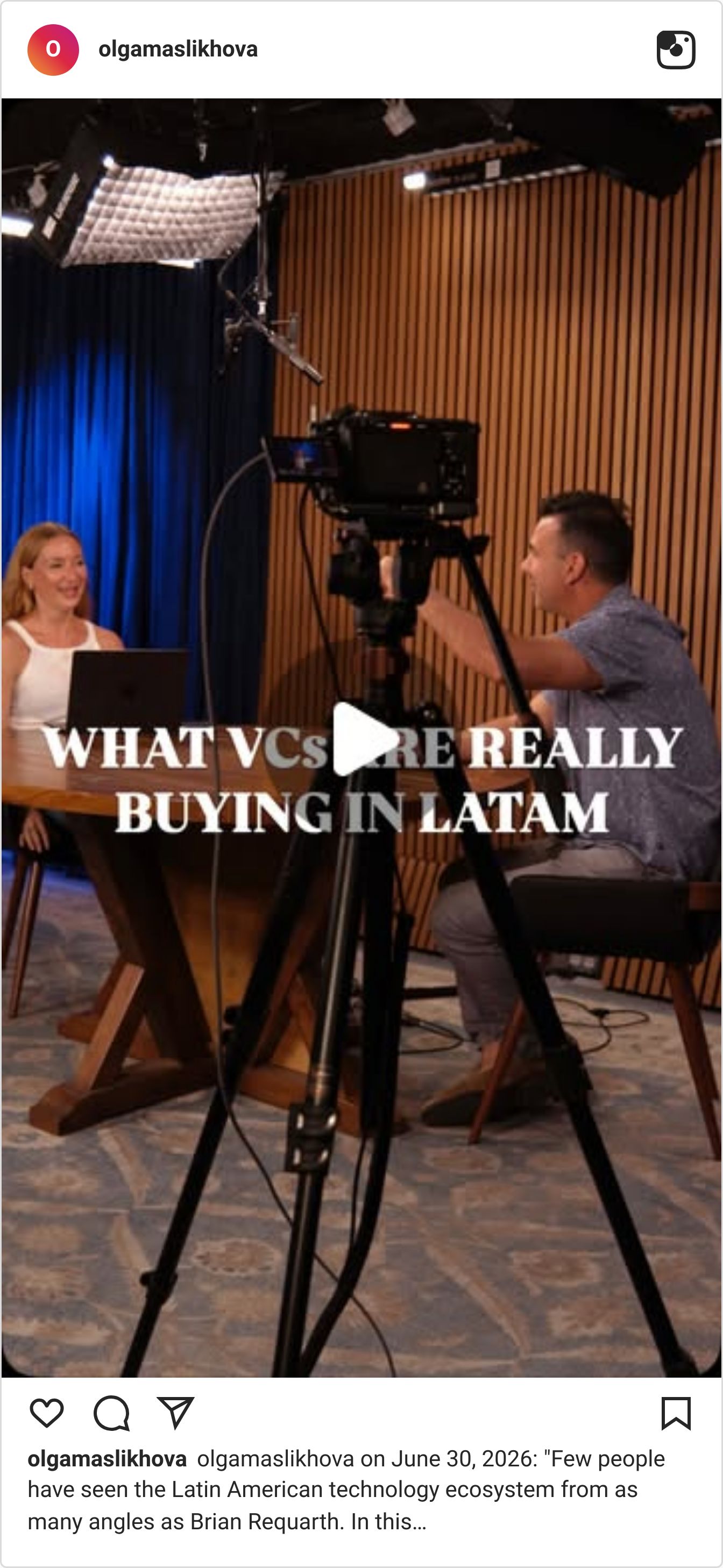
Check out my favorite highlights from our conversation with Brian Requarth here:
What I'm Loving
Watch — The Founder
The McDonald's origin story, and the best business movie about the gap between inventing something and owning it. The McDonald brothers built the perfect system. Ray Kroc built the empire — by realizing the real asset was never the burgers. It was the brand and the land underneath every restaurant. Very relevant to anyone deciding what business they're actually in.
Listen — Acquired: The Walt Disney Company
I'm finishing this one now — the business of Disney. The numbers alone are worth the runtime: the Experiences segment — parks, cruises, resorts — generated more than half of Disney's entire operating income last fiscal year, a record $10 billion on $36 billion in revenue. The characters were invented decades ago. The castles print money today. There is no better case study in IP compounding.
Referral Program? Referral Program!

Two milestones. Two rewards built for founders.
Refer 3 founders → Unlock the masterclass
Share The J Curve with 3 founders and get access to How to Build a Brand That Raises Money — my complete framework on storytelling, audience building, distribution, and investor relationships.
You'll also get the exact 30-day execution sprint I would follow if I were starting from zero today.
Refer 5 founders → Pitch me directly
Refer 5 founders and unlock a 30-minute 1:1 fundraising and deck review with me.
We'll go through your pitch deck, positioning, fundraising narrative, and investor messaging. I'll tell you what's working, what's missing, and where I'd focus to make the story more compelling.
(Please send your deck at least 48 hours before the call.)
Your referral link is below.
Start sharing ↓
{{rp_personalized_text}}
Your link to share: {{rp_refer_url_no_params}}

Thanks for reading,
Olga
🎙 The J Curve is where LATAM's boldest founders & investors come to talk real strategy, opportunity and leadership.