This Week’s Essay
Howard Marks has a line he comes back to repeatedly in The Most Important Thing:
“You can't do the same things others do and expect to outperform.”
The idea sits at the heart of his distinction between first-level and second-level thinking.
First-level thinking is straightforward.
AI is the future.
Therefore, invest in AI.
Second-level thinking starts with a different question.
If everyone agrees AI is the future...where does all the capital go?
What gets ignored as a consequence? What becomes mispriced because everyone is looking in the same direction?
Right now, almost every conversation in venture revolves around the same handful of companies — OpenAI, Anthropic, xAI and Waymo. In Q1 alone, these four raised $188 billion, or roughly 63% of all venture capital deployed globally.

SOURCES: Capital raised — KPMG / Global VC total, Q1 2026 — CB Insights
Most investors look at that statistic and ask:
How do I get exposure to AI?
Very few ask a different question:
What happens to everything that isn't one of those companies?
Those are fundamentally different ways of looking at the market.
The first is about participating in the biggest investment theme of this generation. The second is about understanding the distortions that theme creates elsewhere.
Nowhere do I see that more clearly than in Latin America.
Take CloudWalk. People used to compare it to Stone and PagSeguro. It's now an AI-driven financial platform running at about $1.7 billion in annualized revenue with $322 million in pre-tax profit — and still growing more than 100% a year.
Or iFood, which is anything but a purely food-delivery company. Last year it did roughly $2 billion in revenue, $430 million in EBITDA, and moved nearly $30 billion through the platform. EBITDA grew 40%. A third of that revenue now comes from businesses that have nothing to do with delivering food — the fintech arm alone did close to $500 million and more than doubled.
Plata may be the fastest-growing digital bank the industry has ever seen.
In under three years it passed $600 million in annualized revenue, reached 3.5 million customers, and became Latin America's most valuable private digital bank — all running on underwriting it built itself.
QuintoAndar isn't just digitizing real estate either. It's building the technology infrastructure for one of the world's largest housing markets — roughly $4 billion in annual transaction value, 300,000 rental contracts under management, and nearly $400 million going into AI and technology over the next two years.
Asaas is evolving from a payments tool into a financial operating system for Brazilian SMEs, growing revenue 64% while more than tripling net income last year.
And the list goes on. QI Tech is building the banking rails increasingly embedded across Brazil's financial system. Mottu is assembling one of the world's largest motorcycle ecosystems.
These companies are growing 50% to 100%+ in some cases. Many already profitable. All operating in markets measured in tens of billions of dollars annually, which gives them exceptionally long runways to keep compounding.
Capital was never abundant here. But the businesses got better while the competition for them got weaker.
If I were deploying a $200 million or $300 million growth fund today, I would absolutely own AI.
But I wouldn't stop there.
I'd spend just as much time looking at what all that concentration is making cheap. Which, to me, is growth tech in Latin America.
They're profitable. They're operating in massive markets. They're using AI to strengthen already exceptional businesses rather than hoping AI will become the business.
And they're competing for a dramatically smaller pool of growth capital than they would have just a few years ago.
That's exactly the kind of asymmetry I want to spend my time underwriting.
Howard Marks often says that superior investing isn't about buying good assets. It's about buying them when other people don't fully appreciate what they're becoming.
Today, everyone is trying to find the next OpenAI. I'm increasingly interested in the next CloudWalks and iFoods.
Community Picks


|

|

|
1. AI won't kill SaaS. It'll kill average SaaS.
Mission-critical software survives — the systems companies can't rip out without breaking something. Everything else has to go back to the drawing board. Tomorrow's winners won't own better software. They'll own proprietary data, customer workflows and trust. Those are the three things a model can't replicate on its own.
2. AI will become dramatically better. AI companies will become dramatically less profitable.
Enterprise AI spending today is irrational — budgets set by fear rather than returns. That corrects. Customers optimize their spend, combine cheaper models, and inference costs keep collapsing. Intelligence gets cheaper every year. Which means the economic surplus shifts away from the AI companies and toward their customers.
3. Venture secondaries are a game of just 50 companies
The secondary market is projected to reach $250 billion. But buyers aren't hunting through thousands of startups. They want a tiny group of obvious winners. Which changes the job entirely. In a market that concentrated, access is becoming more valuable than selection.
4. The biggest risk in venture is mega funds
Mega funds need mega deployments, and more capital chasing the same deals pushes valuations higher. Higher entry prices compress future returns. This is the part people keep missing: great companies don't automatically become great investments. What you pay determines what you make.
5. The next trillion-dollar AI company might not train a single model
The bigger opportunity may sit on top of them. Orchestrators combine multiple models, optimize for performance and cost, and reduce vendor lock-in. As models themselves become commodities, the layer that routes between them becomes more valuable than any one of them. The margin moves up the stack.
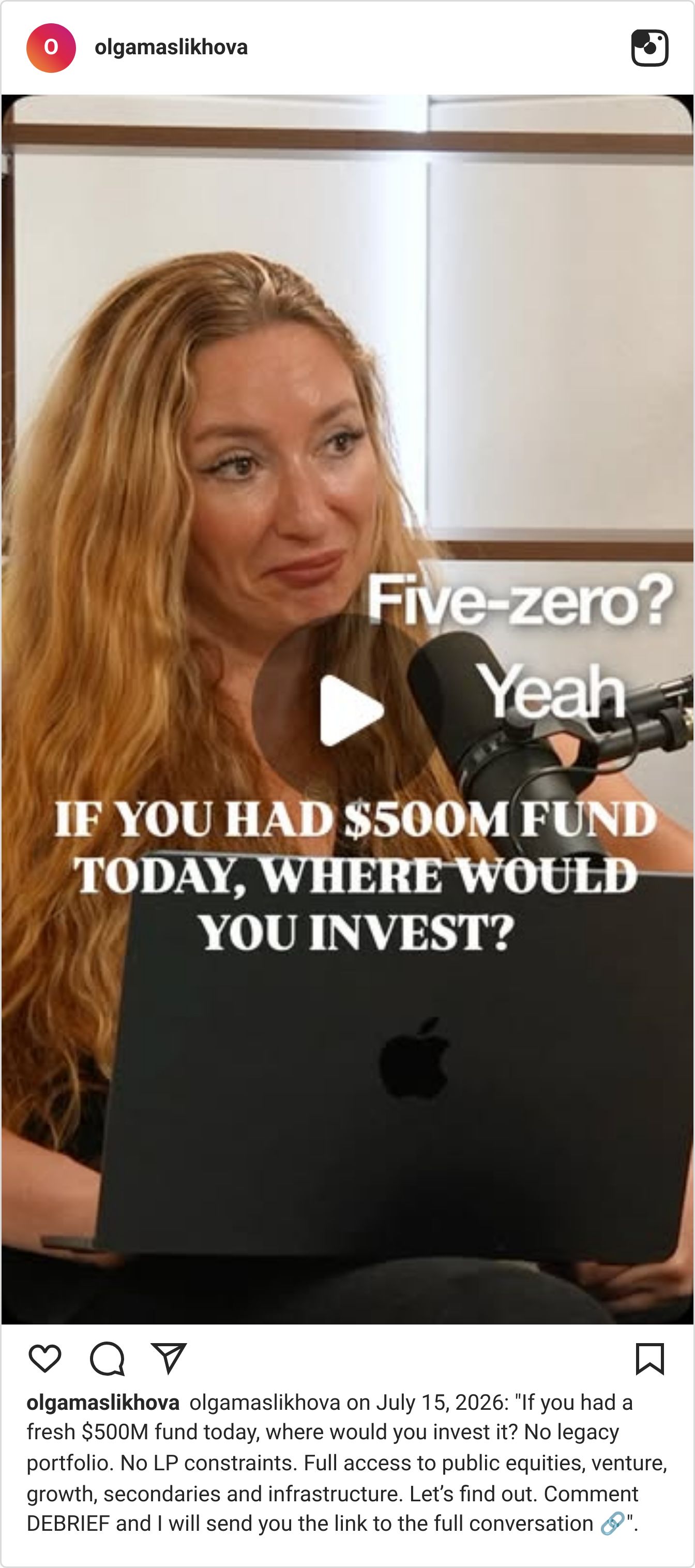
Check out my favourite moments in this highlight reel:
What I’m Loving
Read — CAA and TPG Are Betting $250M That Distribution Is the New Moat (Variety)
The creator economy just crossed another threshold. CAA and TPG launched a $250 million vehicle to acquire creator-led media businesses—not sponsor creators, own them. Their bet is simple: in the AI era, attention is scarce, distribution is everything, and creators have spent years building what everyone else now wants. From Whole Foods to Anthropic, companies increasingly need audiences they don't own. Creators already do.
Read — The People Who Will Thrive in the AI Age (David Brooks, The Atlantic)
One of the best essays I've read on AI this year. Brooks argues the defining divide won't be between people who use AI and people who don't—it will be between those who use AI to deepen their thinking and those who use it to outsource it. His conclusion is difficult to forget: as intelligence becomes abundant, the scarce resource isn't IQ. It's the willingness to think.
Read — AI Is Becoming a Populist Political Issue (The New York Times)
Super interesting geopolitical takes on AI. While the West frames AI as a race to build the best proprietary models, China is increasingly positioning open-source AI as a global public good. If AI becomes a political issue—as energy, the internet and semiconductors eventually did—the winner may not simply be the company with the best model. It may be the country that convinces the world it's building AI for everyone.
We’re Hiring
The J Curve has reached the point where we need another builder.
We're looking for a Content & Distribution Manager to help us turn every episode into a world-class content engine across YouTube, LinkedIn, Instagram, X and our newsletter.
If you've ever wanted to build a modern media company from the inside—and care deeply about storytelling, distribution and quality—we'd love to meet you.
Role description and application: Click Here
Referral Program? Referral Program!

We launched The J Curve referral program.
Two milestones. Two rewards built for founders.
Refer 3 founders → Unlock the masterclass
Share The J Curve with 3 founders and get access to How to Build a Brand That Raises Money — my complete framework on storytelling, audience building, distribution, and investor relationships.
You’ll also get the exact 30-day execution sprint I would follow if I were starting from zero today.
Refer 5 founders → Pitch me directly
Refer 5 founders and unlock a 30-minute 1:1 fundraising and deck review with me.
We’ll go through your pitch deck, positioning, fundraising narrative, and investor messaging. I’ll tell you what’s working, what’s missing, and where I’d focus to make the story more compelling.
(Please send your deck at least 48 hours before the call.)
Your referral link is below.
Start sharing ↓
{{rp_personalized_text}}
Your link to share: {{rp_refer_url_no_params}}

Thanks for reading,
Olga
🎙 The J Curve is where LATAM's boldest founders & investors come to talk real strategy, opportunity and leadership.